Here’s the brutal truth about campground marketing in 2026: “campgrounds near me” pulls around 450,000 monthly searches in the U.S., and “RV parks near me” adds another 246,000. That’s nearly 700,000 people every month actively looking to book, typing into Google and booking wherever the top results send them. If your park isn’t showing up, that revenue is going straight to your competitor down the road. SEO for campgrounds is how you change that, and this guide shows you exactly where to start.
Local search optimization for RV parks and campgrounds isn’t complicated, but it does require doing the right things in the right order. This article gives you exactly that: a prioritized action plan covering your Google Business Profile, keyword strategy, on-page fundamentals, local citations, content, and technical health. Work through it section by section and you’ll start compounding direct bookings without paying OTA commissions.
Make Google Business Profile your booking engine sidekick
Your Google Business Profile (GBP) is one of the highest-leverage assets in your local search toolkit. It’s free, it shows up in the map pack before organic results, and it lets campers call, get directions, or book without ever visiting your website. Many campground owners set it up once and never touch it again, and that’s a massive missed opportunity. For a step-by-step setup, see our Google Maps for Campgrounds: A Step-by-Step Setup Guide.
Set categories and attributes the right way
Start with your primary category set to Campground, then add RV Park and Camping Cabin as secondary categories if you offer those. Don’t add Hotel. Google uses that category to serve reviews asking about “rooms” and “front desk staff,” which creates a mismatch that confuses guests and hurts your ratings. Keep your business name clean with no keyword stuffing; Google penalizes that, and it looks spammy to real people scrolling through results.
Fill every available attribute that applies to your park. The attributes that correlate most strongly with higher local pack visibility include pet-friendly, Wi-Fi, RV hookup, free parking, restroom facilities, pool, kid-friendly, wheelchair-accessible entrance, and groups welcome. These feed directly into Google Maps filters and AI-generated summaries. When a family searches for a “pet-friendly campground with Wi-Fi,” your listing either shows up in those filtered results or it doesn’t. Attributes determine that.
Photos, products, and Q&A that convert
Upload a solid batch of authentic photos, aim for at least 10, showing your hookups, restrooms, cabins, office, playground, and any waterfront views. Add short captions that naturally include your location and amenity terms. The GBP Products section is worth testing for listing RV sites, tent sites, and cabins with price ranges, though availability varies by account. Seed the Q&A section with real questions your guests ask at check-in, then answer them with complete, informative responses that naturally include location and amenity language.
Post regular GBP updates with seasonal promos, upcoming events, or new amenities, weekly if you can manage it, at minimum monthly. Always include a “Book Now” link with UTM tracking so you can see exactly how much traffic and how many bookings come through your GBP. Most owners skip UTM tags and then wonder if their GBP is actually working.
Review prompts and replies that climb the local pack
Reviews are a direct ranking signal. Create a frictionless ask: a QR code at check-in, an automated text after checkout, or a link on your Wi-Fi splash screen. Reply to every review promptly, ideally within a day or two. In your replies, weave in natural phrases such as “RV park in [city] with full hookups” or “pet-friendly campground near [landmark]” where they fit organically; this reinforces your location and amenity relevance without feeling forced. For negative reviews, respond with specifics about what you fixed and invite the guest back. This shows prospective campers you’re responsive and accountable.
SEO for campgrounds: keyword targeting that mirrors how campers search
Campers don’t search the way marketers write. They type “campgrounds near Smoky Mountains,” “full hookups Asheville NC,” and “camping cabins with fireplace Tennessee.” Your job is to build a keyword map that reflects that language and assign one core topic per page to avoid cannibalization. Solid campsite SEO starts here, at the intent level, not the keyword list.
Map high-intent terms to pages
Your homepage targets your primary location query: “[City, ST] Campground” or “RV Park near [Landmark].” Your RV Sites page targets “full hookup RV sites [city].” Your Cabins page targets “camping cabins [city]” or “glamping near [region].” A Tent Camping page, a Group Events page, and a Seasonal Leases page each own their own keyword territory. This structure prevents your pages from competing against each other and gives Google clear signals about what each page covers. For a practical checklist of recommended site pages and features, see What Pages and Features Should a Professional Campground Website Include?.
Build your title tags using this template: [Primary term], [City, ST] | [Brand Name]. Keep them under 60 characters so nothing gets truncated in search results. Your H1 should mirror the same intent in natural headline form. Competitive analysis consistently shows top-ranking campground pages run 1,000 to 2,000 words on key pages, with structured H2 sections for Amenities, Nearby Attractions, Rates, and FAQs. Short pages don’t rank for competitive queries.
Seasonal and amenity-driven content clusters
Think beyond generic “campground” queries. Build content clusters around what actually drives bookings at your park: snowbird season, fall foliage weekends, fishing tournaments, lake access, dark sky stargazing, boat ramp availability, or proximity to national parks and trail systems. These topics represent specific search intent with meaningful volume, and far less competition than broad terms. Keyword research tools like Google Search Console, Semrush, or even free tools like Google Trends can help you verify volume and competition for your specific region. Pages that mention drive times, RV rig clearances, pet rules, and pull-through availability answer the questions campers actually have before they book.
Local citations and industry listings that boost maps
Google cross-references your business data across the web. When your name, address, and phone number (NAP) match consistently everywhere, it builds trust and improves your map pack position. When they don’t match, it creates confusion that hurts rankings.
Industry directories that count for campground visibility
Claim and optimize your listings on The Dyrt, Hipcamp, Campendium, RV LIFE Campgrounds, Good Sam, Campspot, and your state tourism website. These platforms generate real referral traffic and the domain authority of established camping directories reinforces your local signals. Make sure your categories, amenities, and photos on each platform align with your GBP. Add a booking link with UTM tracking where each platform allows it, note that some directories may strip UTM parameters or use nofollow links, so verify each platform’s policies before assuming tracking will carry through. Campspot also provides platform-specific guidance, see Campspot’s SEO best practices for campground owners for details on optimizing listings.
For backlinks, join your local chamber of commerce, regional tourism board, and any trail or outdoor recreation associations in your area. Sponsor community events and request a link in the recap post. Pitch local outdoor bloggers for stay reviews and provide a media kit with high-resolution photos to make the ask easy. These local, topically relevant links carry significantly more weight than bulk citations from generic directories.
Content strategy that fills sites all season
A blog post nobody reads is worse than no blog at all because it wastes your time. The content that drives campground bookings falls into three categories: destination guides, amenity spotlights, and seasonal campaign pages. For ideas and examples you can adapt, check our Campground Marketing Ideas: Our Blog.
Publish what travelers actually use to decide
Destination guides work because campers plan trips around attractions, not accommodations. Write guides covering distances and drive times to top nearby attractions, parking notes for big rigs, and sample two-day itineraries. An amenity spotlight answers the specific questions that turn a browser into a booker: What’s the Wi-Fi speed? How many amp service options do you offer? Are pull-throughs available for 40-foot rigs? Where’s the dump station? Include real photography, a short embedded map, and a booking CTA at the end of every major section.
Promotion without the platform tax
OTA commissions typically run anywhere from 15 to 25 percent per booking, confirm the exact rate in your own OTA contracts, as it varies by platform and agreement. Even one direct booking can meaningfully offset your monthly SEO investment, depending on your average booking value. Encourage direct bookings by offering perks for booking through your website: early check-in, a firewood bundle, or a discount on a return visit. Use email capture with a simple lead magnet, like a printable packing checklist or a local trail map PDF, to build a list you own outright.
Technical foundations and ROI tracking you can trust
Technical SEO isn’t glamorous, but a slow or broken website kills rankings and conversions simultaneously. Google’s Core Web Vitals targets give you a clear benchmark: LCP (Largest Contentful Paint) under 2.5 seconds, and CLS (Cumulative Layout Shift) under 0.1. Currently, only about 22 percent of sites pass all three metrics, which means fixing yours puts you ahead of most competitors by default. For a hospitality-focused perspective on these metrics, see the analysis of Core Web Vitals for hospitality sites.
Speed, schema, and clean URLs
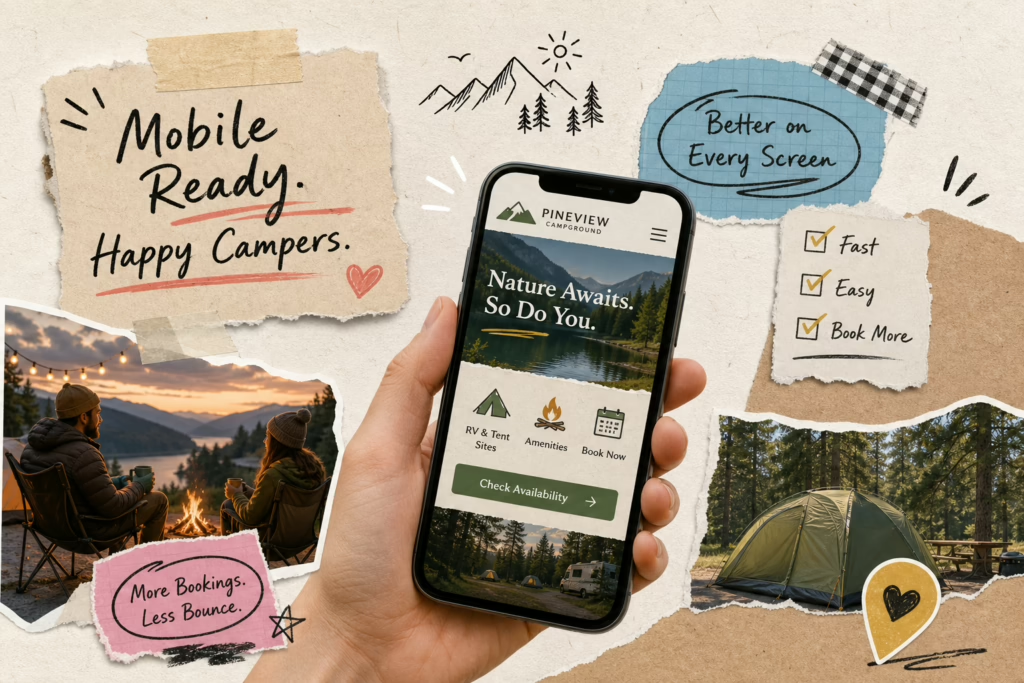
Compress and lazy-load images, serve WebP format, enable caching, and use a CDN. Simplify your mobile navigation to prioritize three buttons: Book Now, Call, and Directions. For structured data, implement the Campground schema type (a direct subtype of LocalBusiness) with GeoCoordinates, AggregateRating, and FAQ schema where relevant. For more on the benefits of structured data, read why schema markup matters. Across top-ranking U.S. campground pages, the vast majority use LocalBusiness or Campground schema rather than LodgingBusiness, which is better suited for hotels. Use clean, location-based URL slugs like /rv-sites-asheville-nc/ and /cabins-near-smoky-mountains/. Submit your XML sitemap to Google Search Console and fix any 404s.
Prove the ROI with simple math
Set up GA4 events for “Start reservation,” “Complete reservation,” phone clicks, and form submissions. Tag all GBP links with UTM parameters. Then run the math: average revenue per booking divided by your monthly SEO cost equals your cost per acquisition. Compare that to what an OTA charges per booking. For most independent campgrounds, organic search delivers a dramatically lower cost per booking than any third-party platform once the rankings are established.
The campground SEO checklist: quick wins to start now
Do this today (30 minutes):
- Verify your NAP in GBP, set primary category to Campground, add RV Park and Camping Cabin if applicable
- Add a UTM-tagged booking link and test click-to-call on mobile
- Upload 10 authentic photos with short captions
- Update your homepage title tag to: Campground in [City, ST] | [Brand]
- Ask three recent guests for a Google review using a short link
Do this week (7-day sprint):
- Build your keyword map: location queries, amenity terms, cabin and glamping phrases
- Publish or polish one high-intent page (Cabins or RV Sites) with FAQs and a Book Now CTA
- Claim Apple Maps and Bing Places; fix NAP on Yelp and Tripadvisor; add Campground schema
- Set up GA4 events for reservation starts and phone clicks; connect Search Console
Do this monthly (compounding habits):
- Request 5 to 10 reviews and reply to all of them using amenity and location terms
- Post one GBP update with a seasonal hook, add one photo batch, publish one local guide
- Audit citations for consistency and add one quality backlink from a local partner or tourism site
SEO for campgrounds: when the checklist is more than you can handle
Running a campground is a full-time job. Running it while also managing your Google Business Profile, writing landing pages, building citations, and tracking GA4 events is a different job entirely. Most park owners know what needs to happen, they just don’t have the hours to make it happen consistently.
That’s exactly the problem that RV Park and Campground Websites (Built By RVers) was built to solve. Because the team are active RVers with deep web design experience, they already know what makes a camper choose one park over another, and they build your site accordingly. Their model includes a $0 upfront custom website build tailored specifically for campgrounds and RV parks, with booking-focused copy, built-in SEO, Google submission, mobile optimization, and monthly updates handled for you. Every month you get a traffic report and a campground marketing newsletter so you always know what’s working. You send an email when something needs changing. They handle everything else.
If you want to implement this RV park SEO playbook yourself, you now have everything you need. If you’d rather have specialists who live and breathe campground marketing handle it for you, RV Park and Campground Websites (Built By RVers) is the done-for-you option built specifically for park owners like you. Either way, the best time to get serious about local SEO for campgrounds is right now, before your competitors do.